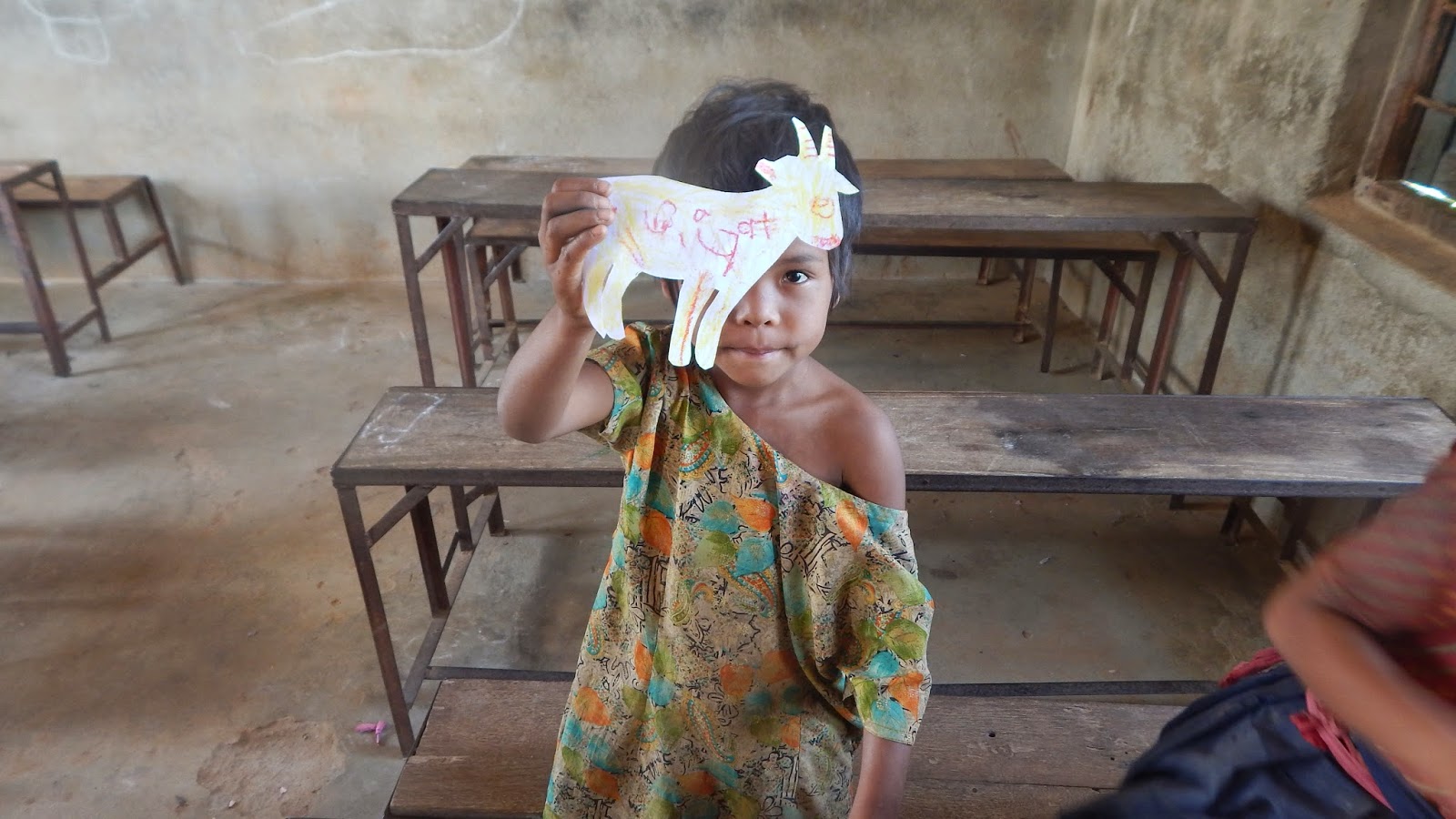
Welcome to my first grade classroom. My school combined the kindergarten and class one because of low student numbers. The class consists of students ages 3-6. Below, you can get a peek of my hand-made teaching materials and my wonderful students in action. It's amazing how quickly they are learning. Teaching them is a joy!
Welcome to my classroom. It’s an exciting place. Recently, I
have been teaching verb tenses to my fourth and fifth grade students. During my
teacher training in the United States, I learned about different learning
styles. While some students learn best auditorally, others learn best kenesthetically,
musically, pictorially, or in other ways. In Nepal, most teachers teach
straight from the textbook lecture-style. Students do not get many
opportunities to get up and active in class. So, when teaching my students
about verb tenses, I decided to do it from a multi-sensory approach.
Games: Kinesthetic and Auditory
I created two different games for teaching verb tenses. The first game is good as a pre-assessment or introductory game, and the second game is good for review after tenses have been studied in class.
Game #1: Verb Tense Hot Lava
My classroom has a concrete floor, so I can draw on it with chalk. Don't worry, I erase it afterwards. On the floor, I drew three rows, past, present, and future like below. Then I would say a sentence like "Yesterday, I ran to school," Today, I run to school," or "Tomorrow I will run to school." I would have all of the students stand below the first line of the chart. Then, they would jump into the correct tense. The last student to jump into the correct tense was out. The students enjoyed this game very much. The winner got a free pencil, which increased motivation to learn. This game was also helpful because students got to see other students jump into the correct tense.
Future
Present
Past
Game #2: Ring the Bell
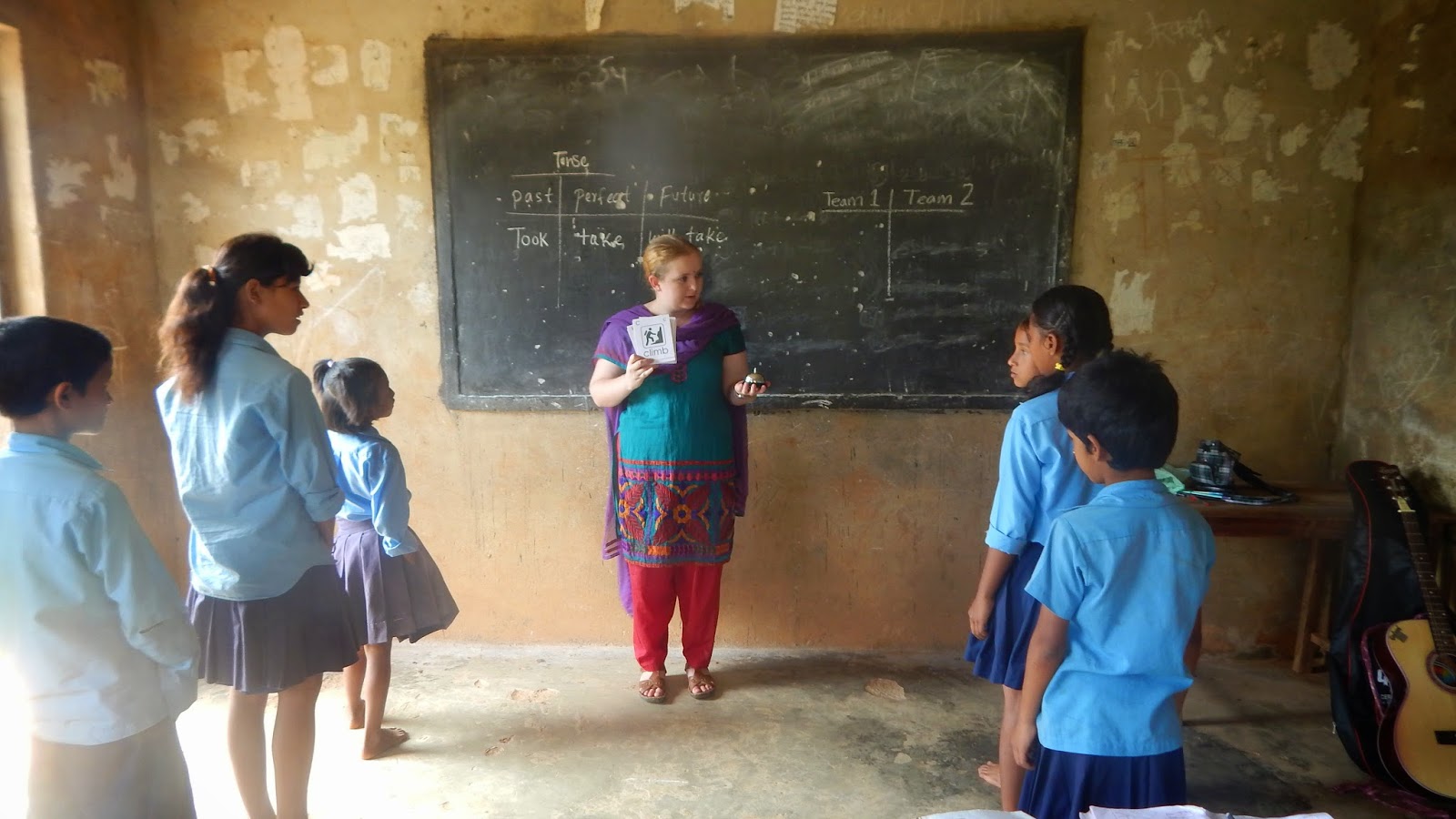
I had my students in both class four and five play this game. First, I split the students into two even heterogeneous groups and had them stand in two lines, across from a student of the same ability level. I stood at the front of the lines holding a bell, and a verb flashcard. I then would say a full sentence like "past tense...Yesterday, I to school." while I held up the verb flashcard "to run."The first student to ring the bell and say the sentence correctly won a point for his or her team. The students enjoyed this game very much.
Verb Tenses Comics
I had my students create verb tense comics. Check out the pictures below!
The Verb Tense Song
Last but not least, I brought my guitar to school, and taught my class the verb tense song. Check it out below.
In addition to writing sentences, reading explanations from the textbook, and listening to stories in the past tense, my students have made so much progress this week! I am very proud of their hard work.
Over the past few days, my students have been taking exams in all subject areas. The results have been disheartening. Today, I watched a five-year-old boy in class two stare at his exam for two hours. Tears welled-up in his eyes when I slowly asked him "what is your name? Write your name here" in both English and Nepali again and again. He could not write his name in either language. The expression on his face is frozen in my mind. I recently discovered that my school is "English Medium" for grades one through four, meaning that the language of instruction in all subjects, except Nepali, should be taught in English. Only one out of the five teachers at my school can hold a conversation in English. The result of this curricular design is dampening the students' ability to speak, read, and write in both Nepali and English. The extent of the student's English consists of "How are you today, I am fine," and "My name is ______." As I sat in class two today proctoring the English exam, I was bombarded by students asking me endless questions about each section of the exam ---ten loud voices shouting all at once "miss, miss miss!" I could not understand most of what they said because my Nepali is very limited. Another teacher heard their loud voices and came to help me. She patiently explained each question to the students in Nepali. She asked the students each question in Nepali. She showed the students what plurals are. She showed the students how to fill in the missing letters. She even said the names of some of the letters in both English and Nepali, and many still did not understand. Part of me wonders how we can really know what the students know after such practices, but part of me already knows the answer---no teacher wants to collect a class-full of empty pages. Today was a wake-up call. Every day I walk to school, and am greeted by the friendly "Namastes" and "Namaskars" of my students. I wish I could sit down with them and talk for hours about their lives and dreams. The language gap between us is as wide as the distance between Nepal and the United States—but at least our smiles are bi-lingual. Today, I realized that I will not succeed at teaching English in my school without the support of my fellow teachers. If they want their school to teach through the English Medium, we need to create a community of learners that are surrounded by the English language on a daily basis. The students will not be comfortable and confident speaking English until all the teachers are. I realize it is not the teachers' fault that they do not speak English. Many of the teachers at my school have been teaching for decades, and know how to teach well—they engage the learners, know the content material of instruction, and care deeply for the wellbeing and success of each child. "I used to be proud of my teaching," the social studies teacher said to me in Nepali. She has been teaching for over thirty years. When she taught in Nepali, her students understood—achievement and a mutual sense of accomplishment between the students and the teacher was present. One day, the decision was made to change the language of instruction to English, as my teacher trainer in Nepal puts it, a "more international language." No one checked to see if the teachers could actually speak English before implementation. No support or resources were given to help teachers learn English. "What can I do?" the social studies teacher asks. What can she do? The day the curriculum switched to English Medium, she, and other teachers were expected to wake-up, go to school, and suddenly be fluent in English. Thus, the vicious cycle began. From talking with teachers, members of my host family, and members of NELTA (Nepali English Language Teachers Association), I have learned that the small government "supported" primary school where I teach is just one of many schools throughout Nepal, and the Gorkha region, experiencing the same challenges. So, what can I do?—or more importantly what can we do? And by we, I mean the teachers at my Nepali primary school, members of NELTA, my fellow Fulbright ETAs from America, and anyone who cares about helping the children of Nepal learn. Significant progress regarding these challenges cannot be made by a single individual on a large scale. The foundation of a good education begins with exceptional teachers—teachers that are well-trained, well-read regarding best teaching practices, well-versed and knowledgeable in their content fields, and fluent in the language of instruction. I have found that if teachers in more rural areas of Nepal want to learn English themselves, there are few resources aside from bi-lingual dictionaries to aid them in this challenging task. To help my students, and other students at similar schools, I will begin teaching a class next week for primary school teachers in the Gorkha area who want to improve their English speaking, listening, reading, and writing skills. This class community will also serve as a forum for discussing the successes and challenges of teaching in primary schools across Gorkha. The class will be free of charge, and will meet once a week on Saturday mornings. The five teachers at my school will come, and I hope to have at least five to fifteen teachers from other schools join us as well. I feel that teaching this class is one of the best things I can do to help the students indirectly. I think the teachers will be able to learn a great deal of English in the seven months that we will learn together, and perhaps even gain the confidence they deserve to successfully teach in English. I believe that together, we teachers from Nepal and the United States can bridge the language-learning gap. I think I have discovered my true career calling! I want to start a program/organization that brings exceptional teachers from the United States to countries that are struggling to implement English Medium instruction in government schools. From my research, I have learned that this is a common challenge in many developing countries. The American teachers would travel to the country of their choice during summer vacation and provide free English classes to ESL teachers abroad. In the coming months, I will talk with the wonderful director of Fulbright Nepal about this idea. Who knows where it will go.
Somehow, my host siblings knew I would choose their family. I asked them how they knew, and they said that when the six American ETAs visited their house, I had joy in my eyes. "We just knew you would come," they said, "and today we have a new Didi (sister)." When my host father came home from teaching, he said "today I am so happy because I have another daughter now."
Interestingly, the members of my host family are not the only people who knew I would come to Shree Gorkhali Primary School. One of the ETAs from last year was neighbors with Sabitra, the English teacher at my small primary school. When I told Kelly, the ETA from last year where I would be teaching, she said, "Somehow I knew you would be working with Sabitra."
After visiting the six schools and homestay families, I couldn't imagine myself spending eight months in Nepal anywhere except with the family and school where I am now. Never in my life have I so powerfully felt that the gift of a greater power has brought me here to this place.
When I visited my school, it was during vacation time, so I did not get to meet any children. Yesterday, before moving in with my homestay family, the NELTA (Nepali English Teachers Association) stopped to talk with the headmaster of my school. I got a first glimpse of the children I had traveled across the world to meet.
I saw the children in class two shyly watch me as I spoke with their loving teacher, Sabitra. There were about ten students. I wish I had a picture of that moment to share. Ten small faces, some with snot dripping from their noses, eagerly peering out of the classroom door. What beautiful children. Suddenly my arms were covered in goose bumps because in that moment I knew I had come to Nepal for each of these children.
Today, my name is Sarswoti Kapri; a name given to me by my host siblings. Together, they took me on a walk to show me their school, also the place there their father teaches math. As we stood on the roof, they pointed out a collection of homes and explained that the people who live there are very poor. My sister Sankalpa said something along the lines of, "these people have been treated very poorly, but I think it is important to give love to all people and not look down upon them." It was a beautiful moment. I told her I admired her profound statement. Earlier in the day, I had jokingly mentioned that I needed a new name because all of my host siblings' names began with the letter "S." Suddenly, Sankalpa said that she thought of a name for me, Sarswoti, the Hindu goddess of knowledge. Today, not only do I have a new name, I wholeheartedly feel part of a beautiful Nepali family. What a gift.
It's hard to imagine that I have been in Nepal for about a month now. I've been so busy taking everything in, that I would have 100 blog posts to document every exciting experience, but there are only so many hours in a day. Now that I have completed my 60-hour Nepali language learning program, teacher training with the brilliant Christine Stone, and selected the school where I will teach, I am ready for the real adventure to begin. As I pack my bags to move in with a Nepali family and finally begin teaching, I fondly reflect on the highlights of an exciting month in Kathmandu.
My highlights include..
being chased in the streets by children saying "Namaste"
discovering mint lemonade
realizing that Nikita, a Nepali friend from college lives less than 3 minutes from my apartment and joining her for a delicious dinner.
drinking mint lemonade
the moment "Rumahl/Napkin" the giant moth was released into nature and I could actually go to bed (see previous post for the full story)
drinking mint lemonade
the delicious dal bhat lunches at Fulbright (I still crave it...)
buying a cheap guitar that sounds great!
teaching Lisa and Caitlin how to play the guitar, going with them to buy guitars, and listening them play "All Too Well" by Taylor Swift (100+ times).
having a motorcyclist stop about 1/2 an inch away from my leg and having him stop traffic to say "Oh, sorry 'bout that" in a busy intersection.
not losing my leg.
walking through Thamel (a touristy retail area) with my friend Alanna and having a man trying to sell a high pitched instrument that sounded like nails on a blackboard ask us "You like?" and my friend Alanna stating "no" so forcefully that the poor man looked like he was going to cry.
drinking mint lemonade
having an overlong conversation in Nepali class about how to use the hose on the side of squat toilets in Nepal without drenching your clothes. (I still don't know how to do this...)
visiting the Boudha Stupa at 6:30 in the morning--probably the most beautiful place I have ever been. (learn more about the Boudha Stupa here).
being given a tour of Patan and learning about Newari culture from a former Fulbright scholar from Nepal. (learn more about Patan here).
visiting the Swayambhunath Stupa (aka Monkey Temple) at dusk and watching the sun set over Kathmandu. (learn more about Swayambhunath here).
seeing baby monkeys at Swayambhunath Stupa.
practice teaching with Ellen at a Tibetan refugee school and ripping the name crowns we had made for each student in half when we realized we had over 40 students and had been told there would be under 20.
visiting the home stay families and schools in Gorkha and Lalitpur and having Christine Stone, our teacher trainer, bring her dog Nim, a large sheep dog, along for the 5 hour car ride.
having lunch with the Nepali Teach for Nepal grantees and talking with them about education
talking with my friend Santosh about children's homes in Nepal, and getting a grown man to help me finish coloring my school supplies.
spending a month living with five amazingly creative and inspirational people.
Oh yeah, and learning Nepali...
and...drinking mint lemonade
Swayambhunath Stupa
look! a monkey!
BABY MONKEY!
Pensive Monkey
Mother and BABY MONKEY!
Boudhanath Stupa
Boudhanath Stupa
Practice Teaching at the Tibetan Refugee School with Ellen
One of the most unique things about the Fulbright ETA
program in Nepal is that we get to choose the school and homestay family that
will shape our experience. There is something beautiful about choice. The
Fulbright commission selected six schools and six homestay families—three in
the Gorkha district near the Bazar and three in Lalitpur near Lubhu. All of the
schools are government schools and many of the students come from marginalized
backgrounds.
Tomorrow, tomorrow, tomorrow, I can’t wait until tomorrow.
We are going to Lalitpur to visit three schools and three homestay families. Last
week at this time, I was packing my bags to go to Gorkha. We visited three
beautiful schools and three wonderful homestay families there. After tomorrow
we will have seen all of the possible schools and families that could
tentatively be our home for the next eight months. Among ourselves, the six ETAs will decide where each of us will be living and teaching.
The view from Gorkha
The view from a hilltop in Gorkha
The Lower Secondary School in rural Gorkha
The Lower Secondary School in rural Gorkha
Students at the Higher Secondary School in Dashkilo, Gorkha