Thursday, February 5, 2015

Village Sister, City Brother: The Script of our 5th Grade Play

It is hard to believe that almost eight months have gone by. My heart sinks when I think about how difficult it will be to leave my students and host family in only one month. I have fallen in love a thousand times over with the resilient smiles of children who are ready to learn each morning despite the myriad sufferings of life's unyielding journey. In these last days, I try to capture how lucky I am as I embark upon my beautiful morning walk to school, amid the rice paddies and farms, the warm namastes from everyone I pass—I will not forget that this has been my home.

On one of my morning walks, I began to write a story in my mind as I reflected upon the countless times I met mothers along the dirt path asking me to take their children to America. I was overwhelmed with the impulse to leave my students with a story about the struggle of experiencing a sense of belonging in today's developing world. But, I did not just want students to hear the story, I wanted them to experience the story. Thus, later that night, I sat down and wrote the following play for my 5th grade students. The play will be performed on my last day of school, along with songs, and a learning gallery in which each class will present the beautiful work they have created over the past eight months. In many ways, this play is a metaphor representing what I have learned from the exceptional students through our eight months together. I hope that the play will touch their hearts like they have touched mine.


Village Sister, City Brother


Narrator 1:
Once upon a time, in a small village, a twin brother and twin sister were born. Their mother and father were very happy, and they loved them very much,

Narrator 2:
When the twins were twelve years old, there was a very cold winter. All the plants in the village died, and there was no food.

Father:
We are going to the city to look for food.

Mother:
We will return to the village in one week.

Narrator 3:
But a month passed by, and they did not return. Soon, news came to the village that the twin's parents had died.

Narrator 4:
The twins were very sad, and did not know what to do. They had no money, and no food. They missed their parents very much.

Narrator 1:
There was one man in the village who owned a small restaurant. He wanted to help them.

Restaurant Owner: (to sister)
If you come and clean and cook at my restaurant, I will give you some food.

Sister: (to brother) 
What should I do?

Brother: (to sister)
You should do what you can to survive.

Narrator 2:
So, the young girl agreed to cook and clean dishes at the small restaurant. She was very sad because she could not go to school.

Narrator 3:
The restaurant owner also had a brother who lived in the city.

Restaurant Owner: (to brother)
A young boy like you does not belong in a village like this. You should go to the city and live with my brother. In the city     you can study at a good school.

Narrator 4:
Thus, the young boy decided to leave the village to study in the city.

Brother: (to sister)
I will miss you.

Narrator 1:
And with those words, he left the village where his grandfather's grandfather had been born.

Narrator 2:
A year passed by, and both the brother and sister were very sad.

Brother:
I dislike the city very much. I have no family here, I have no friends. All I do is study. I miss the clean village air; I miss the farms and the friendly people—I miss my sister.

Sister:
I dislike the village very much. People treat me like property because I am a girl. I want to go to school. I want to  learn. I want to make a difference in the world. All I do is wash dishes and cook food all day. I wish I was in the city.

Narrator 3:
One day, the brother called his sister.

Brother: (talking on the phone)
I want to come back to the village.

Sister: (talking on the phone)
Good, because I want to go to the city.

Narrator 4:
So, the brother and sister decided to change places.

Narrator 1:
At first, the brother was happy in the village. The air was clean, and the people were friendly. But soon, he too became tired of washing dishes and cooking food all day.

Brother:
I dislike the village very much. I miss going to school. I miss my sister. I don't belong in the village, and I don't  belong in the city. I don't know where I belong.

Narrator 2:
At first the sister was happy to be in the city. She loved going to school, but the other students were not kind to her.

Unkind Student 1:
 Hey village girl, go milk some goats.
(Unkind Student 2 and Unkind Teacher laugh)

Unkind Student 2:
Village girl can't even read.
(Unkind Student 1 and Unkind Teacher laugh)

Unkind Teacher:
Village girl is so stupid.
(Unkind Student 1 and Unkind Student 2 laugh)

Narrator 3:
The girl felt so sad. It was not her fault that she had not been allowed to go to school when she was small because she was a girl. All her life, she had dreamed of going to school, but now she did not want to go to school anymore because her teacher and classmates were so unkind.

Sister:
I dislike the city very much. The people are so unkind. I don't know if I ever want to go to school again. I don't belong in the city, and I don't belong in the village. I don't know where I belong.

Narrator 4:
One day, the brother called his sister again, and told her that he did not belong in the city, and that he did not belong in the   village.

Brother: (talking on the phone)
I miss you sister, I want to see you again.

Sister: (talking on the phone)
I miss you too dear brother. Let us meet in between the village and the city tomorrow and we can  talk.

Narrator 1:
The next day, the sister and brother traveled to the town between the village and the city. Before they could talk to each other, they met a kind teacher on the side of the road.

Teacher:
Welcome! Come quickly, you are going to miss the lesson. 

Brother:
But...but….we are not…

Teacher:
Oh, don't worry, we have been waiting for you to come.
(The kind teacher takes them to his school. The brother and sister are very confused.)

Kind Student 1:
 Welcome! Where are you from?

Kind Student 2:
Welcome! What is your name?

Kind Student 3:
Welcome! Do you want to visit my house after school?

Brother:
Maybe we should stay here, the people are so friendly and kind.

Sister:
Yes, maybe we should stay here, this is such a nice school.

Brother:
And there are farms with fresh vegetables.

Sister:
And the air is clean.

Brother:
We can keep what we love about our culture, but also move forward.

Sister:
And we can be together.

Brother:
Yes, we can be together.

Whole Class:
We all can be together.


Monday, February 2, 2015

Our Morning Verse

Inspired by the Waldorf model, I  created a morning verse for my students to recite at the beginning of each class. Since implementing the verse in grades 2-5, I have found the students to be more focused and ready to learn.

Building routines and setting high expectations for student learning and participation have been essential ingredients in creating a safe and nurturing classroom environment where all students feel comfortable speaking in English. The repetition of routines like our morning verse, days of the week, weather girl/boy, and word of the day, have brought forth tremendous progress in the never-ending process of learning English.

The following video shows my forth grade students reciting the morning verse. When I first arrived at my school, I was told they would never be able to speak English because they were so shy. While it took a few months to get the students speaking, once the barrier was broken, through the help of routines and repetition, each student has become an active participant in the classroom, eager to speak in English with enthusiasm.


I learn with courage 
I teach with love 
I grow with knowledge 
I know with truth

A 35th Wedding Anniversary

On January 22nd, my Nepali family gathered for a very special celebration--the 35th wedding anniversary of our wonderful host parents. My two sisters came all the way from Kathmandu to celebrate alongside Samjana (my second youngest sister), Sankelpa (my youngest sister), and Saugat (my brother).

Typically, wedding anniversaries are not celebrated in Nepal. A few years ago, though, my host siblings were watching a television show and learned about the celebration of wedding anniversaries. Shortly after, they decided to start the family tradition of celebrating our parent's wedding anniversary each year as an expression of love and gratitude for our wonderful family.

It has been fascinating to learn the story of how my host parents got married, grew to love each other, and eventually created a family. The concept of marriage is very different in Nepal than in America, because the vast vast majority of marriages, even today, are arranged. I have been inspired by many of the couples I have met and the depth of love that they have for one another. Of course, this is not always the case, but it has been interesting to meet so many happy couples that are the result of arranged marriages. It makes me wonder about and question the ingredients needed to create a loving, trusting, and successful relationship.

My host  mother was just twelve years old and was studying in fourth grade when her parents told her that she was getting married. Can you imagine? She was forced to drop out of school, and moved into her in-law's house, where she was forced to cook, clean and do intensive farming labor. My host father was slightly older, a fifteen-year-old sixth grade student, when he was married. He continued going to school, and for most of his teenage years, looked to my aamaa (mother) as a friend rather than a wife.

As the years passed, my host father continued his education and began to understand some of the oppressive practices that marginalized the village women. He began to have more respect for women and the laborious work they did to sustain life in the village. Through his work as a teacher, he began to work towards empowering the women of the village by giving them knowledge, which in many developing countries can be a ticket to freedom. Slowly, my host parents began to love each other as my aamaa began to feel respected and valued as a hardworking wife.

In 1989, they welcomed their first child into the world--a daughter. They decided that no matter what, she would go to school and have an education to open the doors of her life. Shortly after, a second daughter was born, then and third, and a fourth. Today, not only do each of the girls understand the value of education and attend school, but all four of my host sisters are the first students' in their respective classes. My didi (older sister) is now twenty-six-years-old, and is finishing her studies to become a nurse. She was married a year ago, at the age of twenty-five, instead of twelve. It is amazing to see how opportunities for women have changed from the generation of my aamaa to the generation of her daughters. Not only is the 35th wedding anniversary of my host  parents worth celebrating, but the resilience of them growing into love and creating opportunities for their daughters is inspirational and worth celebrating on many levels.

Yum!!! My host siblings had a special cake made just for their parents!

My wonderful Nepali parents! 

The family! (minus Saugat, who took this picture)
The Family!
My host siblings saved their money for a few months to buy their parents a special anniversary gift! 

Tuesday, January 13, 2015

Compassion is Progress


Compassion is Progress


The sun again will rise
Giving loving light
Like in years before
To cities made of glass
To village fields of grass
It touches all the world

Yet humanity sings the song
Of generations gone by
Are we free, are we home, are we there yet?
And if not why? Why? Why? Why? Why? Why? Why?

But all I want to express
All I want to express
Compassion is
Compassion is
Compassion is
Progress

Learn to build the bridge

And still we’re waging wars
And still we’re building walls
And still we’re trying to buy happiness
From local shopping malls

If you can taste the pollution
That’s consuming the skies
If you can put down your wallet
And open your eyes
We’re not free, we’re not home, we’re not there yet.
We’re not free, we’re not home, we’re not there.

And all I want to express
All I want to express
Compassion is
Compassion is
Compassion is
Progress

Learn to build the bridge

We need more than coexistence
We need more than tolerance
‘Cuz this form of division
Is the seed of ignorance—
We need respect and we need justice
For those who've done no wrong
We need heads, hands, and hearts wide open
To accept the love that’s been there all along
Before it’s gone, gone, gone, gone, gone
Love has been there all along

And all I want to express
All I want to express
Compassion is
Compassion is
Compassion is
Progress 

Friday, December 26, 2014

Christmas in Nepal

Let's face it, if you come from a small family, like me, the holiday season can feel quite isolating in the United States. After I passed the age of about ten, Christmas lost it's magic. I became desensitized by the holiday. Christmas was just another day on the calendar. 

Throughout my high school years,  I yearned to experience just one Christmas with a big family, full of warmth, vitality and tradition. Christmas with three people just felt so lonely. Yet, with the distance of going away to college, I began to see the beauty in celebrating Christmas with my parents. After some years, the holidays became a time of reflection and creativity, trying to define what coming and being "home" really means. 

And here I am celebrating Christmas in Nepal with three wonderful Fulbright ETAs and one Fulbright Clinton Scholar. I may not be in the United States, and this Christmas is a bit untraditional, but for the first time, I'm celebrating the holidays with the big family I missed having as a child. From hot showers, to delicious food, wandering up a hill following a woman collecting sticks, to watching the sun rise over the himalaya at dawn, this has been an incredible Christmas that I will never forget.

 
Lisa made a paper Christmas tree, and for our Christmas breakfast, we turned an ordinary tree into a magical one.

The Christmas tree queen and her masterpiece 

A new friend is a good present! 

YUUUUUMMMMMMMMMMMM!!!!!!
We live in a beautiful world! The lake on Christmas morning. 

Although I have not seen any real shih-tzus in Nepal, this cute fuzzy friend was a gift to stare at for a few minutes. 

Bridges bring the world together. 

While wandering through the woods trying to reach the peace stupa at the top of the hill, we met a wonderful woman collecting firewood. She gave us directions that caused us to walk for about two hours on uncharted paths.
We made it through the wilderness! What a beautiful stupa. 
We are family! 

Nameste! 

A Nepali family asked to take a photo with us! We made so many new friends!


Nature knows it's Christmas! 

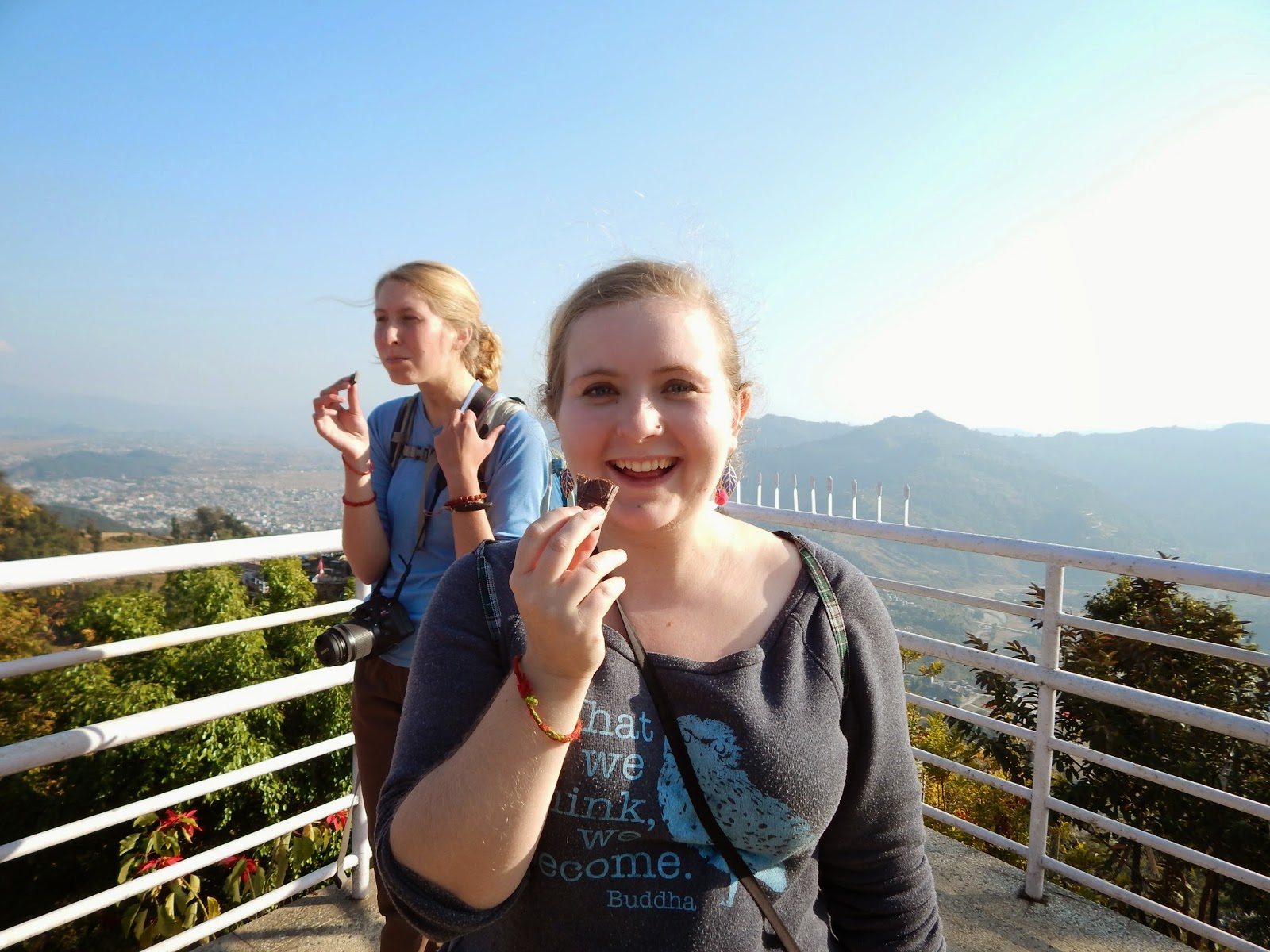
Chocolate with a beautiful view = HEAVEN! 
The sunrise over the mountains


Nepali milk tea, a beautiful view, and great company

Yummmmmm!!!!
This is the definition of a "good" morning.

Wee!!

Yay! 

One...two

three!

Jump!  
On top of the world, jumping for joy! 


Thursday, December 25, 2014

Hands and Words for Helping: Friendship Bracelets with a Cause

Violence plays a prevalent role in the lives of many Nepali children.

I am haunted as I write by the heart-piercing shrieks of a three-year-old child being beaten for not knowing how to write the alphabet. 

A student in second grade comes to school limping one day. A student in class three has bruises on her arm in the shape of two large hands. She is sitting next to a boy with a swollen lip. A student in class five has a black eye.

The two-year-old baby that lives at my house, picks up a bamboo stick and viciously beats her doll, imitating her mother. 

There are other stories that I will not share online...

Sometimes, I feel helpless seeing children's validation be stolen by the violence they encounter every single day. 

I have had to step back and start telling myself, "what you are doing is enough. By teaching, you are giving these children a valuable gift. Your job, in the  classroom, is to give the children the tools they need to create their ideal lives."

So, my goal became simple: I wanted to help build a safe, violence-free, classroom environment where students could feel safe, valued, and empowered. It is a goal that we are still working to bring into action. 

I decided that I wanted my class five students to make a pledge--a pledge that they would no longer harm any of their fellow classmates--with words, or with physical force. As the oldest students in the school, I wanted them to help set the tone of non-violence for the entire school, because many of the younger students look up to them as role models. 

To showcase that we pledge to not harm others, I taught the fifth-grade students how to finger-crochet using woven yak wool that I purchased at the bazaar. During our Creative Arts class, I soon realized that the students really loved finger-crocheting. I decided to give them an assignment. "You are going to make a bracelet, and you are going to give it to one of your classmates; but, every classmate must receive a bracelet, and you cannot keep a bracelet that you make," I said. So, the students all made their bracelets. Then, I had each student give a bracelet to one of their peers. "By accepting this bracelet from your classmate, you pledge that you will not harm any of the students in our school either with words of physical force." After each student received a bracelet, I was happy to see that the students wanted to make more! "Let's make these bracelets for all of the students in the school!" one of the boys said. So, in the coming weeks, the fourth and fifth grade students are going to make bracelets for each student, so that all of us can pledge to use our hands and words for helping instead of hurting. 

Check out the pictures below to see the fifth grade students making their "hands and words of helping bracelets." We wear them every day with pride. 


Friday, December 19, 2014

Take me to America

I see the longing desperation in each mother's eyes when she asks me, "will you take my child with you to America." I fumble to form coherent sentences in Nepali. "I am a simple teacher," I say. "I cannot get your child a visa; that is the job of the American Embassy." I see their eyes turn glassy before they look down at the ground. "What about my husband?" They sometimes ask. I give the same reply. The mothers walk away, but still smile at me when I walk to school, only to ask me the same question a week later.

"Where are you from?" friendly strangers ask on buses, dirt paths, in shops and restaurants. "I am from America," I say knowing what will follow. "Oh! The United States! Will you take me to America?" (silence) "Nepal is beautiful isn't it?"

My host mother tells me stories of what it was like to be married at the age of 13, leave her parent's home, and drop out of school to work in the fields. She too dreams of America. "We will start a farm," she says. "I will cook and clean for your parents as they go old. We will sell vegetables grown without chemicals. Buba will teach math, Sabita will be a doctor, Sirjana and Samjana will be business women while Sankalpa and Saugat finish college."

I think back to the village where my host father and host mother grew up, a three hour walk from the nearest bus stop. I see families living peacefully side-by-side in the houses their grandparents built by hand from mud and cow dung. I see fields and fields of rice, corn, potatoes, cabbage, spinach, apple trees, orange trees, and guava trees as far as the eye can stretch. "This is the way my grandmother lived and her grandmother lived and her grandmother's grandmother lived," my 94-year-old hajuraamaa says with a toothless smile. There was something so beautiful and organic about the village, given that every meal was a result of a relatives' hard work—anything needed to live either came from the earth or the diligence of the villagers' hands. "When the school came, it changed everything," my grandmother explains. "Our children were no longer here to help in the fields, and they began to dream of leaving our village for the city to find work."

I listen in silence, afraid that I will witness "what happens to a dream differed," the innocent notion that simply by coming to America all dreams will come true. I think back to my family's history, their sacrifices, and how such deep tragedy and desperation brought my grandparents to this country. I re-read the words of Henry David Thoreau, Rachel Carson, and Bill McKibbin, questioning the price of industrialization and consumerism. I watch the world news on a ten-inch TV screen in Nepal and start to cry when I see that people are still murdered because of their skin color. I am haunted by Harper Lee when I sleep—along with a thousand Americans asking themselves "where do I belong? America is the land of the free for who? And at what cost?"

My experiences abroad make me question everything—what the presences of schools have done to communities around the world, what will happen if humans continue to turn their back on their relationship with the natural world, and how the price of freedom seems to equate to a t-shirt on the clearance rack at Walmart that no one will ever buy, sewn by the hands of a 13-year-old girl in a developing country longing for a better life.

So sometimes I ask myself, would I trade my life of education and shopping malls for a simple yet arduous existence, planting and harvesting rice, living in a hand-made house, at one with the landscape that generation upon generation of my ancestors had called home? If I had been born in Nepal, would I too beg to ask, "Take me to America?"